Wednesday, August 11, 2021

Entering Canada during COVID

In the before times, we wouldn't normally worry about entering Canada by boat. Eat all produce before we dock, have our passports ready, and call the agent from the payphone. Get the clearance number and be on our way within 15 minutes. 

The pandemic changed things. Sure, entering Canada the day the borders opened wasn't as easy as it used to be, but it could've been much harder. The Delta variant is spreading and we're immensely grateful Canada offered this olive branch to their southern neighbors. Of course, we're ashamed our country didn't reciprocate this symbol of good faith. We understand that not everyone has the privilege to travel based on country of origin, access to the vaccine, and financial means, so it's essential we travel responsibly and never take anything for granted.

So here's our experience with crossing the border during a pandemic. If you're planning to cross soon too, maybe this will prove useful? The updated CBSA site will help you navigate as well. Unlike in the before times, you will now need to set up an ArriveCAN account for your vessel and crew, prove you are fully vaccinated, and present a negative covid test (taken within 72 hours of your arrival).

What we did:

1. We got vaccinated to help slow transmission. Vaccinations work. Even against the more contagious delta variant, the unvaccinated are still at most risk and the hosts for viruses to mutate so rapidly. Canada understands this. Canada is smart.  

2. We scheduled a covid test within 72 hours of our arrival. Since we'd need to get tested, wait for the results, and upload them to our ArriveCAN account, we had to get the test somewhere with reliable internet, preferably close enough to a Canadian port of entry so if the test shows up late, we could make it to Canada in a matter of hours. We couldn't find any appointments on the weekend and none in the San Juans, so Friday afternoon slots in Port Townsend worked for us. Results came in early Sunday morning so we crossed the Strait of Juan de Fuca and staged our boat in Garrison Bay on San Juan Island that night.

3. We looked for open port of entries. Several locations closed during the pandemic. We chose the Van Isle border dock in Sidney because it was close to Garrison Bay and assumedly not as crowded as Victoria or Vancouver.   

4. We filled out our ArriveCAN account with the regular customs necessities (passports, VIN, etc.), immunization records, and entry information within 72 hours of our estimated entry. On the first day, ArriveCAN relaunched updated versions and earlier reservations were lost. If you're entering Canada soon, it may be useful to complete ArriveCAN immediately before you dock.

5. We showed up early so the test results wouldn't expire as we waited. While this may not be necessary in the days to come, the first day was BUSY. We called the Telephone Reporting Centre [TRC] line, waited on hold for about a half hour (most boats experienced waits of and hour or more), and then waited again for another half hour for an agent to stop by our boat and double check documents. 

The border agent strike may be over, but nothing about this opening is easy for them. The ever changing rules and software crashes are just as confusing to them as they are to us, and they're working overtime to make this go as smooth as possible. Procedures will likely change several times in the coming weeks as they work out the kinks. If you're entering Canada during the pandemic, wear a mask, socially distance, and be kind. :)

6. We celebrated! Canada has some of the most beautiful cruising grounds in the world, and we're thrilled to be back here.


Tuesday, August 10, 2021

Canada at Last

“The art of life lies in a constant readjustment to our surroundings.” 

--Kakuzo Okakura, The Book of Tea

We’re still learning this lesson. And while we haven’t yet realized “the art of life,” we’ve adjusted and readjusted several times this year. 

If you know me well, you know I like to be in control. I organize our cruising life with endless calendars and spreadsheets. And when the unknowns associated with the pandemic unsettled our plans, I doubled down. We can only control things we can’t control with more control, right?   

Fortunately, sailing teaches us a different way. We ride up and down each wave, and sometimes we ride out storms. Sometimes we slam into the troughs and sometimes we need to wait for our sails to fill with wind again. We adjust our lines. And most importantly, we approach the unknown with curiosity and excitement. This is where the magic happens, not in spreadsheets and fixed plans. 

Sailing involves risk. And we recently took some big ones. We took a hiatus from careers we enjoyed, and I said goodbye to students I loved. We gave up our steady paychecks, important time with our families, good health insurance, and the comfort of routine, all in search of this magic.  

The ongoing pandemic hasn’t allowed us to return to Alaska and venture further north into Prince William Sound and Kodiak as planned. Nor did it allow us to get a jump start in our bigger ocean crossing plans and sail south to Mexico. At least not yet.

But it has allowed us something better: to go with the flow. And on July 19th, we got good news: The Canadian border would open to vaccinated U.S. travelers on August 9th.

So here we are, anchored in a delightful bay in the Canadian Gulf Islands we would have surely passed up if our earlier plans panned out. We’ll let the wind carry us where it will and explore areas we may not have a chance to explore again. We’ll go at our own pace and let the magic happen. :)


Relaxing in Selby Cove

Magic

Nature provides in a public orchard on Prevost Island


Wednesday, July 21, 2021

Jaunts around the South Sound

Sailing's all about balance, quite literally, so we've tried to balance work with fun this summer. :)

Home sweet Olympia

Tacoma Narrows

McMicken Island


Jarrell Cove

This guy :)


Hope Island


Gig Harbor

Cutts Island in Kopachuck State Park


Blake Island


Penrose State Park

Oh, and we're leaving Washington in two weeks! Stay tuned!

Monday, June 7, 2021

So Close!

Family and friends!

It’s been a while! 


Weather’s warmer, our foulies are dried out, and, though Covid19 postponed our initial departure date, we’re preparing for the next one. The end of the pandemic is in sight!


...And, knock on teak, the end of our enormous list of renovations on De Novo is too (well, for now). We save money by doing almost all projects on our own. But as neither of us have a background in boat maintenance, the learning curve is steep!


Below are the projects we’ve completed since our last blog post. We plan to highlight the biggest or most eventful ones in future blog posts so others can learn from our mistakes and, occasionally, truimphs.  


  Biggest jobs:

  • Replaced all standing rigging with 316 stainless steel (supplied and managed by Puget Sound Rigging)

  • Replaced old freshwater hoses with NSF LLDPE hoses and new fittings

  • Replaced septic system: hoses (OdorSafe Plus), fittings, valves, and head

  • Replaced cracked stanchion bases and added stainless steel rods for deck jerry can storage at the beam

  • Installed Revere Offshore 2.0 Life Raft

  • Patterned and sewed new projects:

    • Seven jerry can covers

    • Two water jug covers

    • A lee cloth

    • Stern line mount cover

    • Electric dinghy motor cover

    • Electric dinghy battery liftbox

    • Hatch mesh sunshade

    • V-berth mattress pad

    • Dinghy cover straps

    • Bosun chair reinforcement 


Other jobs:

  • Packed abandon ship bag

  • Wired a new tri-anchor light at the top of the mast; attached new cups for our wind instrument and upgraded to LED lights while aloft

  • Added a new faucet and an Acuva dual UV and micron water filter in galley

  • Installed radio mic extension cord in the cockpit

  • Replaced our main halyard

  • Installed three reefs for our mainsail

  • Spliced and whipped new lines

  • Installed new storage options around the cabin, including a new shelf above the macerator and airtight trash collection

  • Checked all deck hardware and fittings for chafe; cleaned and applied Boeshield T-9 to all outside metal; greased movable parts such as the boom gooseneck; rebed some deck hardware

  • Re-fiberglassed and gel-coated deck spider cracks and old hardware holes

  • Waxed topsides

  • Hot dipped our 240 ft. of galvanized chain; remarked; spliced 135 ft. of anchor line for a total of 375 ft. of anchor rode; added Dri-Dek to anchor locker to prevent future chain rust

  • Rebuilt new helmstep with the help of our friend Adam; varnished and added non-skid strips

  • Practiced emergency sail-repair with Speedy Stitcher and spare Dacron

  • Added a vent to the starboard water tank so it empties overfill at head sink

  • Tested all bilge pumps; upgraded a Rule 1500 to a Rule 2000 and a replaced a Rule 500

  • Cleaned handheld watermaker, added new hose, tested for bacteria and other contaminants, pickled for storage

  • Replaced propane tanks; moved tanks from lockers to lazarette for better venting and hose sloping

  • Added new berth toppers

  • Recertified fire extinguishers

  • Replaced our worn Sea Eagle inflatable kayak with a durable Advanced Elements Tandem one

  • Did regular engine maintenance

  • Did regular canvas maintenance

  • Replaced hull zincs

  • Bought and stored spares


In-progress: 

  • Rebuilding our refrigeration system with new Isotherm compressor and evaporator plate 

  • Adding kiwi-grip to deck non skid


Left to do:

  • Rebed portlights

  • Install our Monitor Windvane 

  • Practice using ATN gale sail for stormy weather

  • Install 12v fans in cabin


We’re so close to cutting the dock lines and embarking on our next big adventure. Stay tuned!


Random pics from the last few months:


Liferaft installed. Hopefully we never have to use it!

Jerry can covers, color-coded for can type


chain before
chain after


removing boom

Reinstalling the mast and new shrouds

new water filter and faucet

getting to the stanchions


after
before


Installing the lee cloth

New helm step

Why we needed to replace our septic system. Ew

More ew

So clean

Dave's a splicing wizard.

We also fixed up and sold our condo and moved to Olympia to spend time with my family. It's been a busy year!

Cozy new marina in Olympia


Saturday, August 22, 2020

A Haulout During a Pandemic?

This post includes a bunch of boat maintenance stuff. Feel free to skip if this sounds boring. 

In the last blog post, we wrote about keeping social distance while cruising--avoiding marinas, keeping systems maintained and safe, etc. But what about if social distancing isn't possible? What if we absolutely need to pull in and haul out?

We haul De Novo out every other year to work on her hull; since we did this in 2019, we weren't scheduled for another year. In the off-years, we hire Double J Diving to change our zinc anodes and scrub growth off in the water. 

Seacocks:

However, we grew uneasy about a questionable seacock we wished we replaced last haul out. And we can't replace seacocks when the boat's in the water. Despite exercising (opening and closing several times) each valve every few months, we recently found this one wouldn't close. Not good.  

Fortunately, we have some safeguards to prevent our boat filling up with saltwater if the hose attached to the valve were to fail as well. We've tied appropriate-sized plugs to each seacock so we don't have to fumble for the right one in an emergency. We have three bilge pumps: two automatic and one manual. However, two of those four safeguards require we're actually at the boat at all times. In the end, it just made sense to defy the stay-at-home order and haul out this summer. To plan ahead, we decided to replace two seacocks: the one in question and another that could've failed in a few years. Now all seven thru-hulls have solid, structurally sound bronze sea cocks, and we won't need to worry.   

In the interest of cost and safety, we chose Swantown Boatworks in Olympia and tacked it on to the end of our longer summer trip. For those of us who prefer to save money and do most of our own work, it's a much cheaper option than anywhere in Seattle. To prevent virus transmission, the yard spaced boats further apart than normal, used masks, and communicated all details by phone rather than in person. 


Boatyard PPE

Two new shiny bronze seacocks


Propeller: 

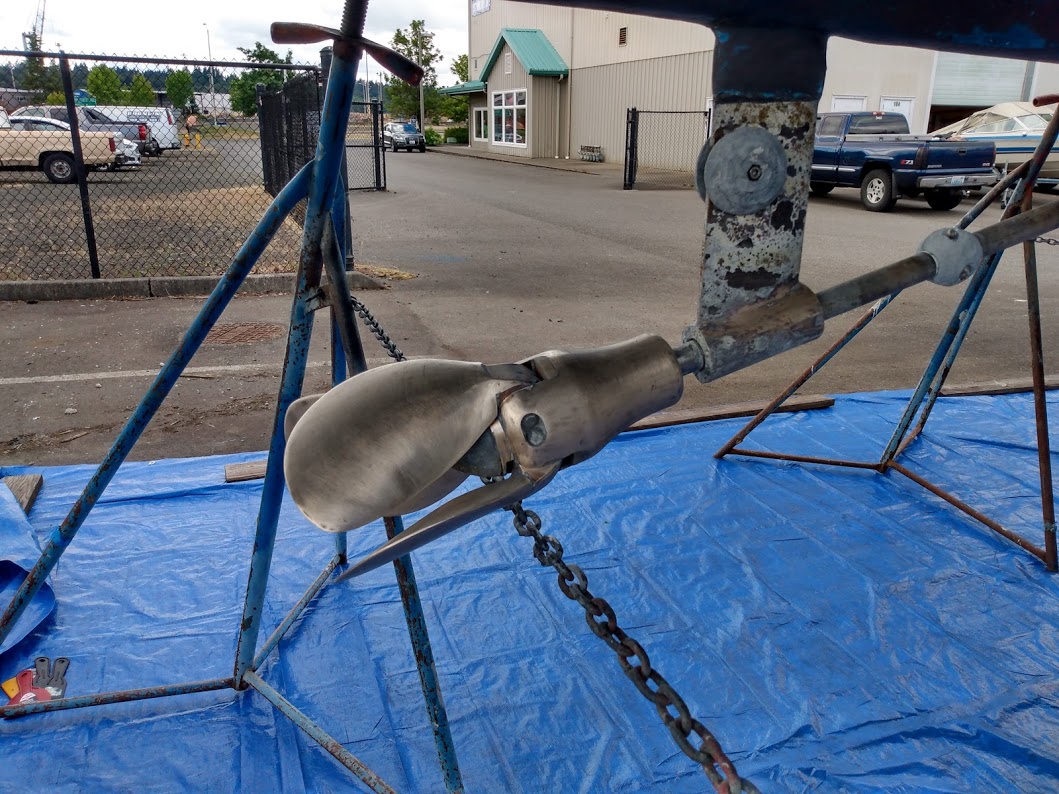
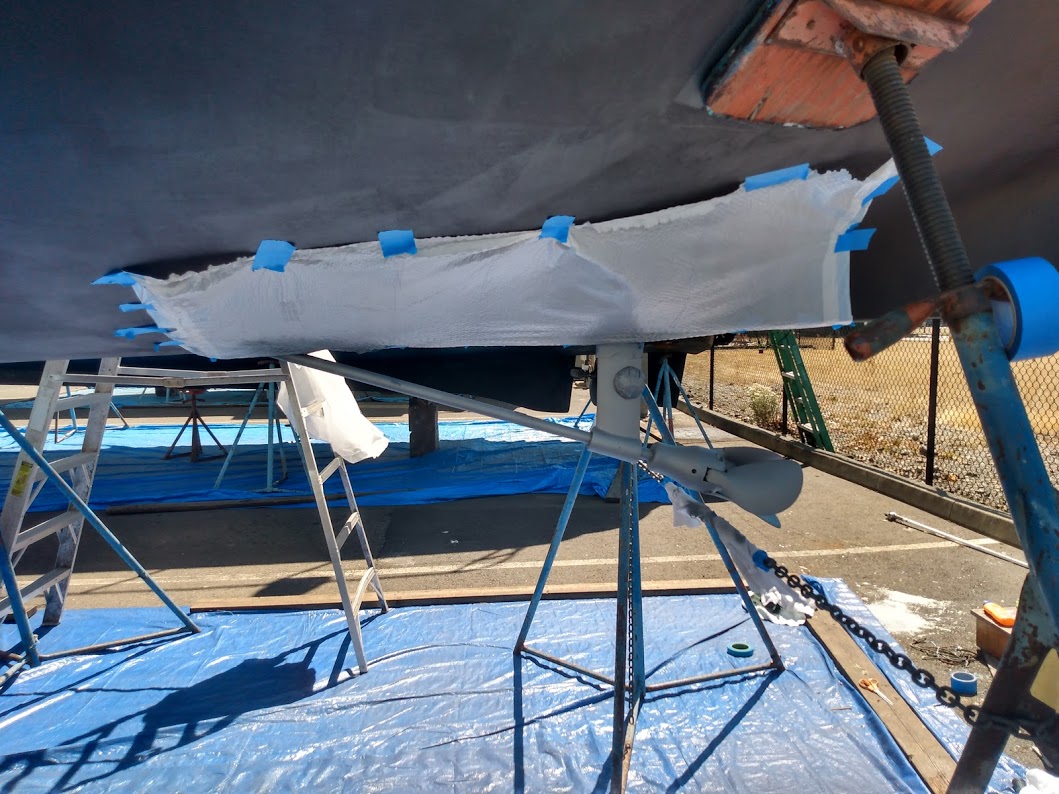
We don't think we did a sufficient job with the propeller last year. After reading about it more, we think we didn't sand it smooth enough and apply enough coats of primer or paint. Due to our user-error, we can't yet determine if Primacon primer and Trilux 33 work, so we're giving them both another shot. If it looks poor on our next dive, we'll upgrade to Propspeed when we haul out again in two years. We'll let you know.   

While we didn't see growth or barnacles, 
the paint already peeled since last year's application.


Sanding it thoroughly with 80, 120, and then 400 grit. 
This combination eventually allowed for a smooth finish.

Spraying three coats of Primacon, sanding with 400 between coats

All done! Four coats of Trilux 33 with light 1000-grit sanding as needed. 
Super smooth. 


Since we were hauling out anyway, we decided to lightly vacuum sand and paint two more coats of Seahawk antifouling on the bottom, wax the waterline, and replace zinc anodes--all tasks we would have done next year. This way, we can save our next haul out until summer 2022 (fingers crossed!). 
 
Our Novi, ready for new adventures